Basque Or Spanish In Bilbao
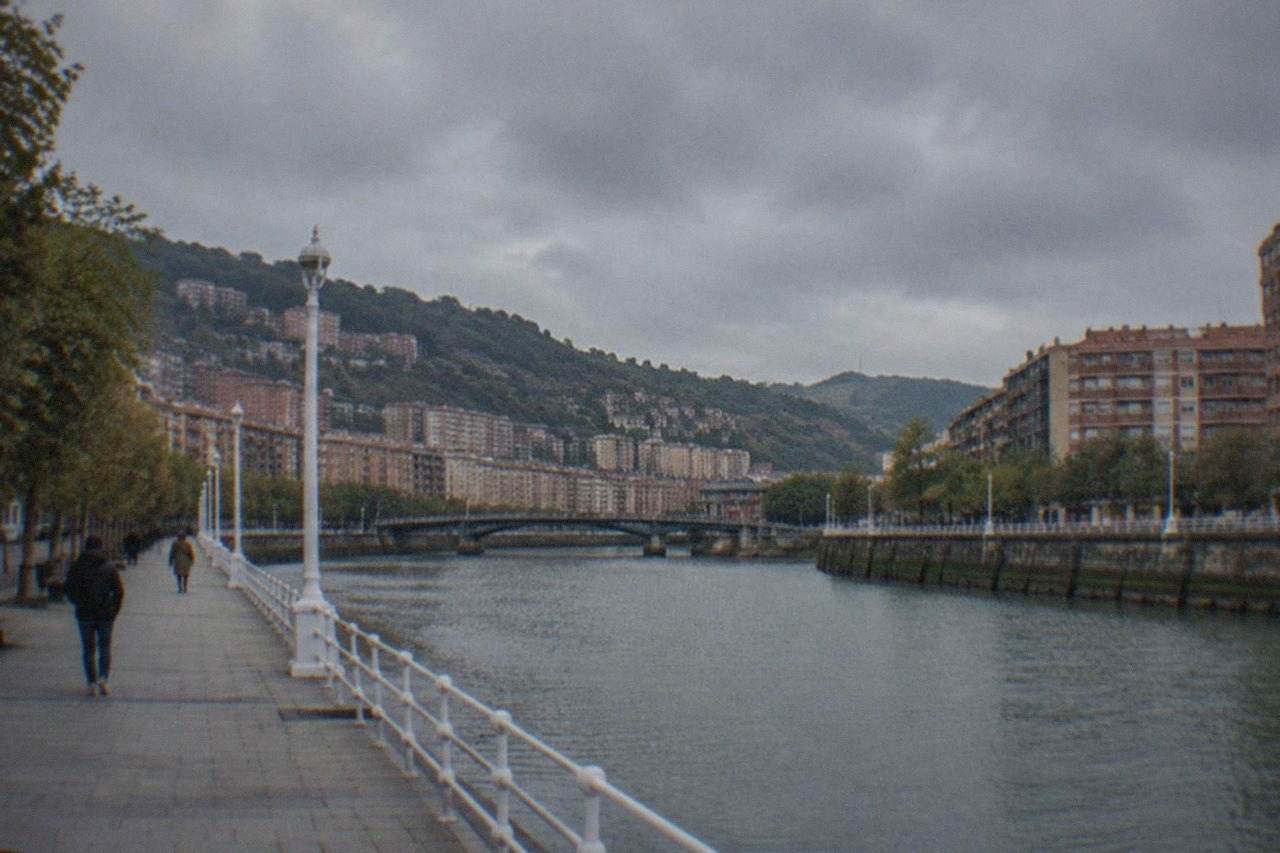
Bilbao, in the Basque Country of northern Spain, runs on two languages at once: Spanish, which nearly everyone speaks, and Basque (Euskara), which appears on every street sign, metro announcement and museum plaque in the city.
Short answer
Both languages are official in Bilbao: Spanish is what most residents speak day to day, while Basque (Euskara) is the co-official language of the Basque Country and appears on all signage. As a visitor you can get by entirely in Spanish or English, but a few Basque words go a long way.
Bilbao, in Biscay (Bizkaia) province in the Basque Country (Euskadi) of northern Spain, is a city that speaks in two voices. Spanish is the language of the street, the shop counter and most dinner-table conversations, but Basque, Euskara, is everywhere too: on the metro line names, the street signs of the Casco Viejo, the banners of the rowing clubs, and the mouths of roughly a third of the residents you will pass. Eustat's municipal register puts the city's population at 346,933 as of 1 January 2025, and within that population the two languages live side by side in a way that surprises most first-time visitors, because Basque is not a dialect of Spanish and is not related to it at all. This guide explains what you will actually hear, what the signs mean, and whether you need a single word of either language to enjoy the city. For the wider political and cultural backdrop, our Bilbao Travel Guide homepage collects the planning basics, and the Basque Country primer for Bilbao visitors sets out the region's story in more depth.
Is Basque Or Spanish The Main Language In Bilbao?
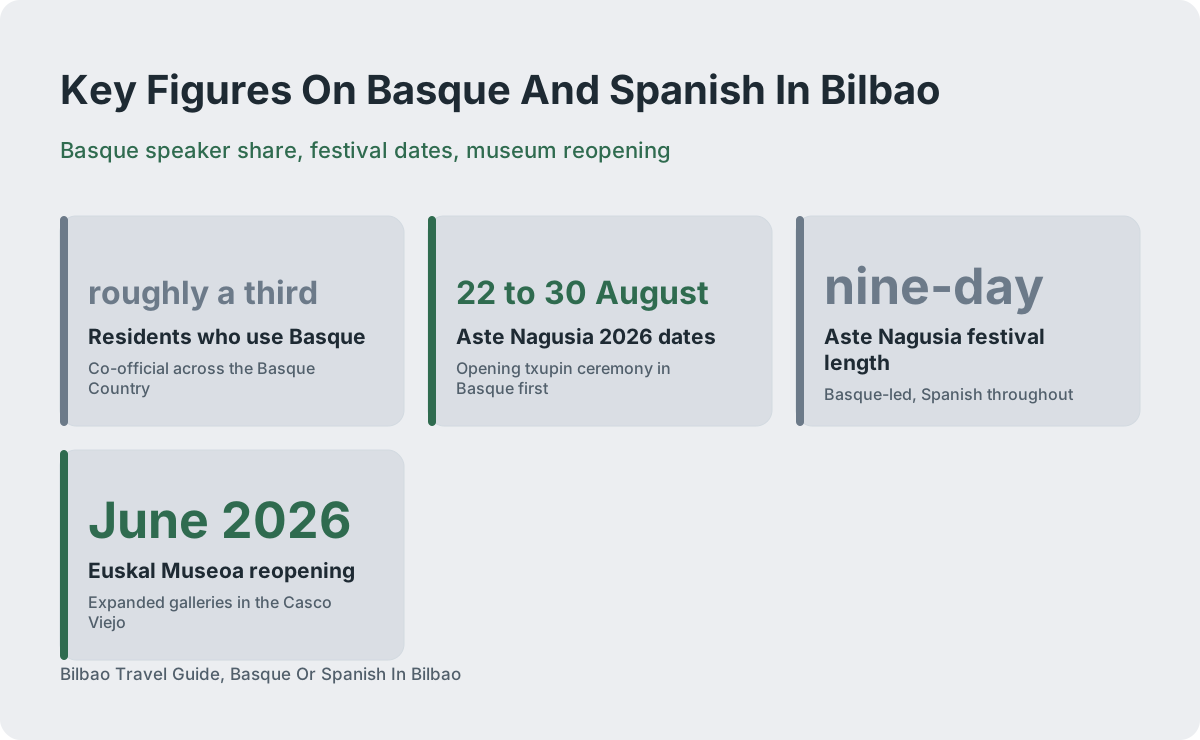
Spanish is the language most residents of Bilbao use day to day, but Basque (Euskara) is co-official across the Basque Country and is used by roughly a third of the city's population, so both are official and both appear on every public sign in the city. Basque has equal legal status in Bilbao even though Spanish remains the majority spoken language, and the split between the two is the single most distinctive linguistic fact about the city.
The Basque Country (Euskadi) is one of Spain's autonomous communities with its own co-official language, and that status is not symbolic. Public administration in Bilbao must serve citizens in either language, schooling operates through extensive Basque-medium streams, and street renaming over recent decades has made the Basque form the default on signage. The city's Basque name is "Bilbo", and you will see it in literature, on plaques and in local writing, though "Bilbao" is the name used in English and in Spanish alike.
What catches visitors off guard is how different the two languages are. Spanish arrived with Castile and belongs to the Romance family, sharing roots with French, Italian and Portuguese. Basque, Euskara, belongs to no known family at all. It is Europe's only surviving pre-Indo-European language, older than the Roman arrival in Iberia, and its vocabulary, grammar and sounds share nothing with the Spanish spoken around it. A resident who speaks both is effectively holding two unrelated languages in one head.
The practical balance shifts by neighbourhood and by generation. Basque-medium education expanded dramatically over the decades since the transition to democracy, so younger residents in the city are far more likely to understand and speak it than their grandparents were, while older residents in some working-class districts may speak Spanish only. In the Casco Viejo, in the bars around Plaza Nueva, and at cultural events, you will hear both within minutes of each other.
Where Will You Actually Hear Basque Spoken In Bilbao?
You will hear Basque most reliably in the Casco Viejo, in schools and family groups, at cultural and sporting events such as the rowing regattas, on public transport announcements, and among younger residents educated in Basque-medium schools, while Spanish dominates shops, restaurants and everyday commerce across the whole city. The metro and tram announce stations in Basque and Spanish, so every visitor hears Basque within minutes of arriving.
Public space is where the two languages visibly share the city. Metro Bilbao announces its stations in Basque and Spanish, and the Basque names are not translations of the Spanish ones but the historically primary ones: Abando, Casco Viejo is "Zazpikaleak" (Seven Streets), and the airport bus stops and transport network all carry bilingual labelling. The Consorcio de Transportes de Bizkaia integrates both languages across metro, tram, bus and Euskotren signage, which is why the getting around Bilbao transport guide is full of names that look nothing like Spanish.
Events are the other guaranteed place to hear the language in full flow. During Aste Nagusia, the city's nine-day festival (22 to 30 August in 2026), the opening txupin ceremony and many announcements are made in Basque first. The estuary rowing clubs, which you can read about in the Bilbao rowing regattas guide, carry Basque names and songs, and txalaparta percussion and bertso poetry performances keep the language as a living performance art rather than a museum piece.
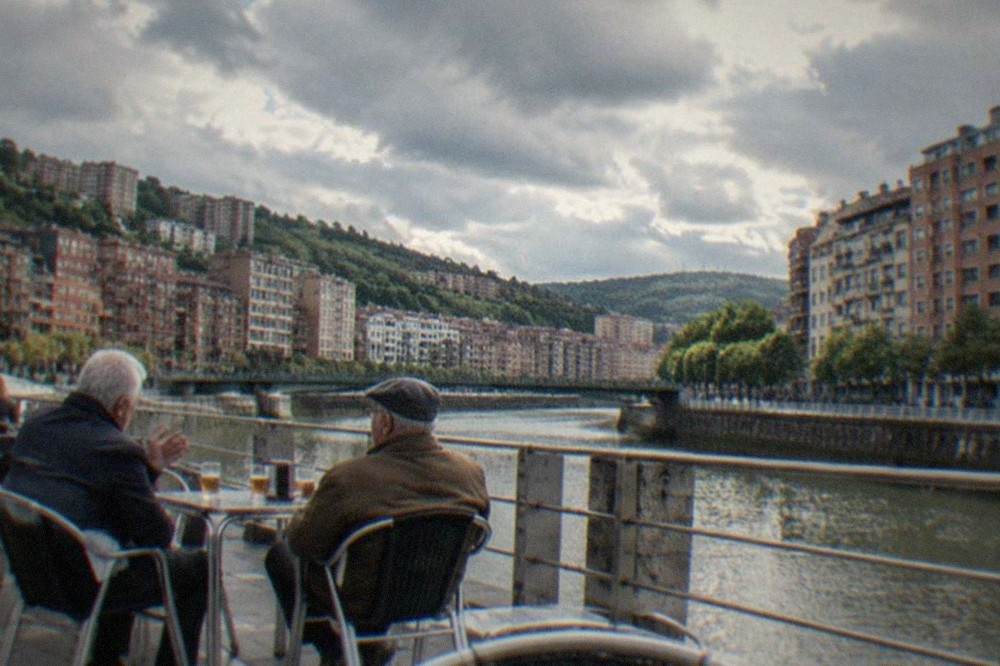
Family and school settings matter most of all. A large share of Bilbao's children are educated through Basque-medium models, and the playground chatter in those schools is often Euskara even when the home language is Spanish. That generational shift is the biggest change in the city's linguistic landscape in living memory, and it means the language is far more audible now than it was under the Franco regime, when decades of suppression had pushed it almost entirely out of public life.
Beyond the city, the language thickens as you move into smaller towns. Bermeo, Mundaka, Gernika and the fishing villages of the Bizkaia coast have higher concentrations of Basque speakers than the capital itself, and the Urdaibai estuary region is one of the strongholds. Day trips out of the city are where many visitors first hear sustained Basque conversation, because the coastal towns are among the most Basque-speaking places in the entire territory.
Do You Need Spanish Or Basque As A Tourist In Bilbao?
You need neither language to visit Bilbao: English works in hotels, the Guggenheim, the main museums and most tourist-facing businesses, Spanish covers practically everything else, and Basque is never required of a visitor. Learning a handful of Basque words, however, earns genuine warmth, because locals do not expect outsiders to attempt Europe's oldest language.
Spanish is the working default. Menus, taxi drivers, market stalls and pintxos bars operate in Spanish first, and a visitor with schoolroom Spanish will manage everywhere in the city. English is strong in the tourism sector, weaker in traditional neighborhood bars, and this is the ordinary pattern of a mid-sized Spanish city rather than anything specific to the Basque Country.
Basque, by contrast, is a courtesy language for visitors rather than a necessity. Nobody in a Bilbao shop expects a tourist to speak it. But the effort is noticed. Greeting a barman with "kaixo" (hello) or thanking with "eskerrik asko" rather than "gracias" marks you as someone who understands where they are, and the reaction is usually a smile and sometimes a small language lesson. The words are short, and the pronunciation is phonetic and consistent, so they are genuinely easy to pick up on the plane.
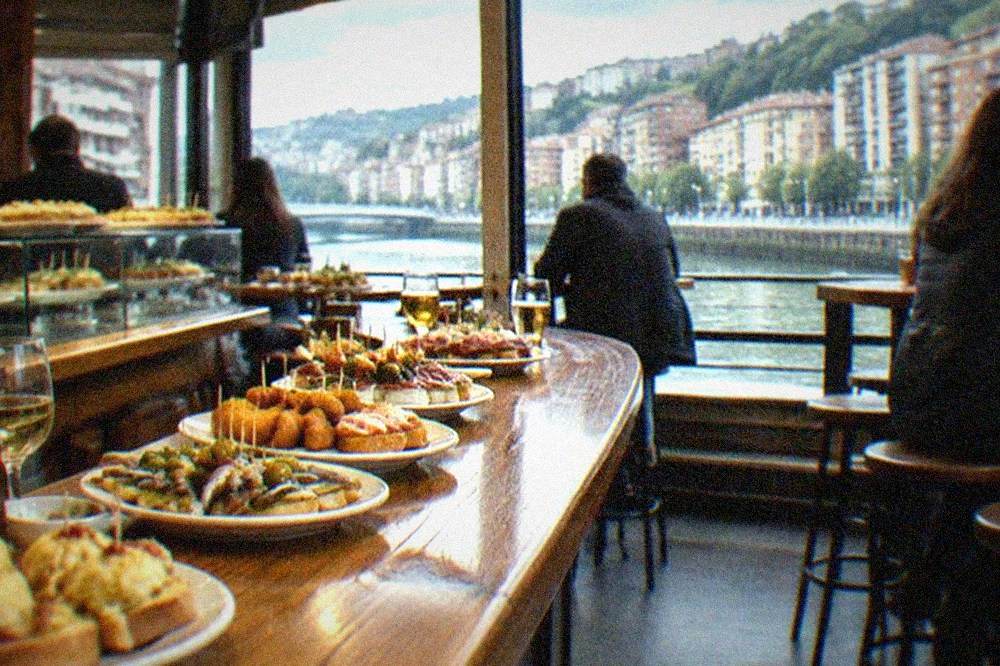
The settings where language matters most to a visitor are the traditional ones: pintxos bars, markets and festivals. The best pintxos bars in Bilbao guide covers the bars where pointing at the counter works perfectly well, but a few words of Spanish smooth the ordering, and the bars of the Casco Viejo are where you are most likely to hear Basque spoken around you while you wait. For a fuller sense of whether the region rewards the trip at all, the is the Basque Country worth visiting answer page weighs the case.
One genuinely useful tip: the Spanish here is northern Spanish, spoken clearly and at a measured pace compared with Andalusia, which visitors with intermediate Spanish tend to find a relief. And if a sign or announcement confuses you, asking in Spanish is always fine. Basque speakers in Bilbao are bilingual by necessity, and the courtesy runs one way: they will switch to Spanish or English for you without a flicker of hesitation.
How Is Basque Different From Spanish In Bilbao?
Basque and Spanish are completely unrelated languages: Spanish is a Romance language descended from Latin, while Basque (Euskara) is a language isolate, Europe's only surviving pre-Indo-European language, with entirely different vocabulary, a grammar built on suffixes added to word roots, and sounds that include letters Spanish does not use, such as the "tz" and "tx" combinations you see everywhere in Basque place names.
The grammar difference is the deep one. Spanish builds meaning through word order and gendered nouns. Basque builds it through agglutination: a root word acquires a chain of suffixes that tell you who is doing what to whom, so a single long Basque word can carry the meaning of a whole Spanish clause. The verb system marks the listener as well as the speaker, which is rare among the world's languages, and there is no grammatical gender at all.
The visible difference is orthographic. Basque spelling uses "tx" for the "ch" sound, "tz" for a harder version of it, and the letter "z" where Spanish would use "s" or "c": Zazpikaleak, Getxo, Txabarri, Zorroza. Once you know that "tx" sounds like "ch" in English "church", half the street signs in Bilbao become pronounceable, which is a small victory worth taking on your first morning.
| Feature | Spanish | Basque (Euskara) |
|---|---|---|
| Language family | Romance (Indo-European), descended from Latin | Language isolate, no known relatives |
| Historical depth in Iberia | Arrived with Roman Latin | Predates the Roman arrival, Europe's only surviving pre-Indo-European language |
| Grammatical gender | Masculine and feminine nouns | No grammatical gender |
| Word construction | Word order plus articles and gender | Agglutinative suffixes stacked on a root |
| Characteristic spellings | ll, ñ, c/z quirk | tx, tz, z, and endings in -a, -k, -ak |
| Example greeting | Hola, Buenos dias | Kaixo, Egun on |
| Example thanks | Gracias | Eskerrik asko |
| Status in Bilbao | Official, majority spoken language | Co-official across the Basque Country, roughly a third of residents use it |
The two languages also borrow from each other, which adds a layer of fun for anyone listening closely. Basque absorbed centuries of Latin and Spanish vocabulary (the word for church, "eliza", comes from Latin), while Spanish took a handful of Basque words in return. The most famous export is "izquierda", the standard Spanish word for "left", which linguists trace to Basque "ezker". Next time you hear a Madrileño give directions, you are hearing Basque at work inside Spanish.
What Do Basque Words And Signs In Bilbao Actually Mean?
The Basque words you will see most in Bilbao are "kaixo" (hello), "eskerrik asko" (thank you), "gaztelugatxe" (roughly "castle rock"), "zubi" (bridge), "kale" (street), "plaza" and "eliza" (church), and once you can read a few of these roots, the street signs, metro stations and bar names across the city stop being noise and start being readable.
The signage is genuinely decodable with a small toolkit. "Kale" means street, so "Zazpikaleak", the metro stop and Basque name for the Casco Viejo, means "the Seven Streets", the original medieval core. "Zubi" means bridge, which is why the suspension bridge at Portugalete is "Bizkaia Zubia". "Ibaizabal", the name of the estuary's lower reach, means "wide river", and "ibilbide" is a path or walkway. Names in Bilbao are descriptions first and labels second.
| Basque word or name | Meaning | Where you will see it in Bilbao |
|---|---|---|
| Kaixo | Hello | Bars, greetings, festival banners |
| Eskerrik asko | Thank you | Signs, and worth saying yourself |
| Egun on | Good day | Daytime greetings |
| Zazpikaleak | The Seven Streets | Metro station and Basque name for the Casco Viejo |
| Kale / kalea | Street | Street signs across the city |
| Zubi / zubia | Bridge | Bizkaia Zubia, the Vizcaya Bridge at Portugalete |
| Eliza | Church | Church signage and maps |
| Udaletxea | Town hall | The Ayuntamiento building's Basque name |
| Ibaizabal | Wide river | The estuary's lower reach |
| Gaztelugatxe | Roughly "castle rock" | The coastal hermitage islet, a top day trip |
| Txakolindegia | Txakoli winery | Wine bars and rural signs |
| Ongi etorri | Welcome | Airport, station and hotel entrances |
Food vocabulary is the most rewarding corner to learn, because it appears on menus even in Spanish-first restaurants. "Txakoli" is the local lightly sparkling white wine poured from a height, "pintxo" is the Basque form of the word Spanish renders as "pincho", "sagardoa" is cider, and "txokos" are the gastronomic societies where Basque is often the only language spoken. The Basque cider and txotx season guide covers the winter ritual where the cider houses of Bizkaia open their barrels, and the Basque Country food and restaurant scene answer explains how the region's language and its cooking reputation intertwine.
A small pronunciation note unlocks nearly everything. Basque is pronounced as written. "Tx" is the "ch" of "church", "tz" is a slightly harder version, "z" is an "s" sound, and every vowel is short and clear as in Spanish. Stress usually falls on the second syllable from the end. Say "Zazpikaleak" as "thas-pee-KAH-leh-ak" with a soft Spanish "th" and you are already closer than most guidebooks get you.
Can You Learn Basque Or Spanish In Bilbao As A Visitor Or Longer Stayer?
Yes, Bilbao is one of Europe's best cities to study either language: Spanish language schools serve short-stay visitors year round, Basque courses for adults run through the city's euskaltegi network and the HABE system, and university-level options exist at the University of the Basque Country, so anything from a one-week survival course to full immersion is available.
For Spanish, the city's schools cater to the standard visitor range: intensive weeks, conversation classes and private tuition. The language schools in Bilbao guide lists the options and what to expect from each. Northern Spanish pronunciation is clear and measured, which makes Bilbao a comfortable place to practice compared with faster-speaking regions further south.
For Basque, the infrastructure is remarkable for a language of its size. The Basque autonomous community runs a public adult-education network of euskaltegis, and distance learning through HABE, with the explicit goal of normalizing the language. A curious visitor can find beginner conversation workshops, and a longer stayer can enroll in the same subsidized courses residents use. The language's regularity helps: once the suffix system clicks, progress is faster than the alien vocabulary suggests.
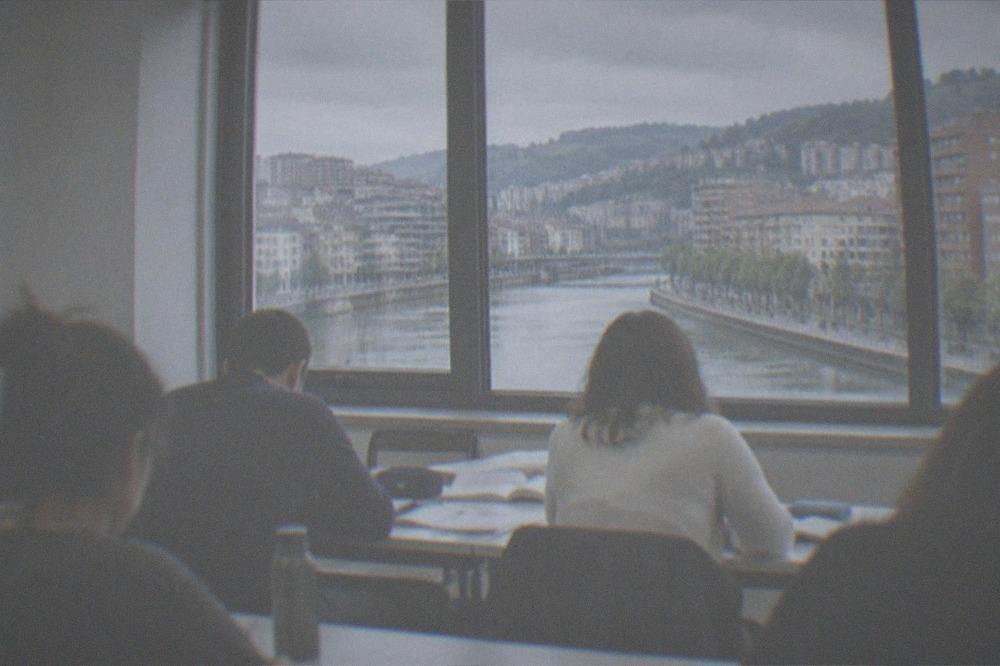
The Euskal Museoa deserves the mention it just got. A page about language in Bilbao should point somewhere you can see the language's deep past, and the museum's expanded galleries, reopened in June 2026 after its renovation, are exactly that place, sitting in the heart of the Casco Viejo where the Seven Streets still carry their Basque name on the metro map.
How Does Language Shape The Basque Culture Around Bilbao?
Basque identity around Bilbao is inseparable from the language: place names, festivals, sports, cider houses and the political history of the region all carry Euskara, and a visitor who understands even a little of the language's story, including its suppression under the Franco regime and its recovery since, will read the entire Basque Country differently, from Gernika's oak tree to the coastal villages where Basque is the first language of daily life.
The historical weight is real and worth handling with care. Under the Franco dictatorship the public use of Basque was banned and its teaching suppressed, and the recovery after the dictatorship ended has been deliberate and state-supported. That is why the language's visibility today, on signage and in schools, is not a quaint custom but a hard-won public achievement, and why locals respond warmly to genuine interest in it. The Gernika tree and Basque history guide tells the political story through the region's most famous symbol, the town that gives the language its most somber historical chapter.
The culture you can simply watch is easier. Rowing regattas on the estuary, rural sports such as stone lifting and log cutting, bertsoa improvised verse sung in competition, txalaparta drumming: all of these are performed in Basque, and several are spectator events you can stumble into for free during summer weekends. The festival calendar in the Aste Nagusia festival guide is the peak of it, when the txosnas (festival bars run by neighborhood konpartsak) carry Basque names and the announcements alternate between the two languages.
| Cultural setting | Language you will encounter | What it sounds or looks like |
|---|---|---|
| Metro and tram announcements | Basque and Spanish, alternating | Station names first in Basque, then Spanish |
| Aste Nagusia festival | Basque-led, Spanish throughout | Txupin opening speech, konpartsak bar names |
| Rowing regattas on the estuary | Basque | Club names, trainera boat chants |
| Pintxos bars of the Casco Viejo | Both, Spanish-led | Counter talk in either, menus mostly Spanish |
| Cider houses in season | Basque-led | Txotx call, songs, txoko cooking clubs |
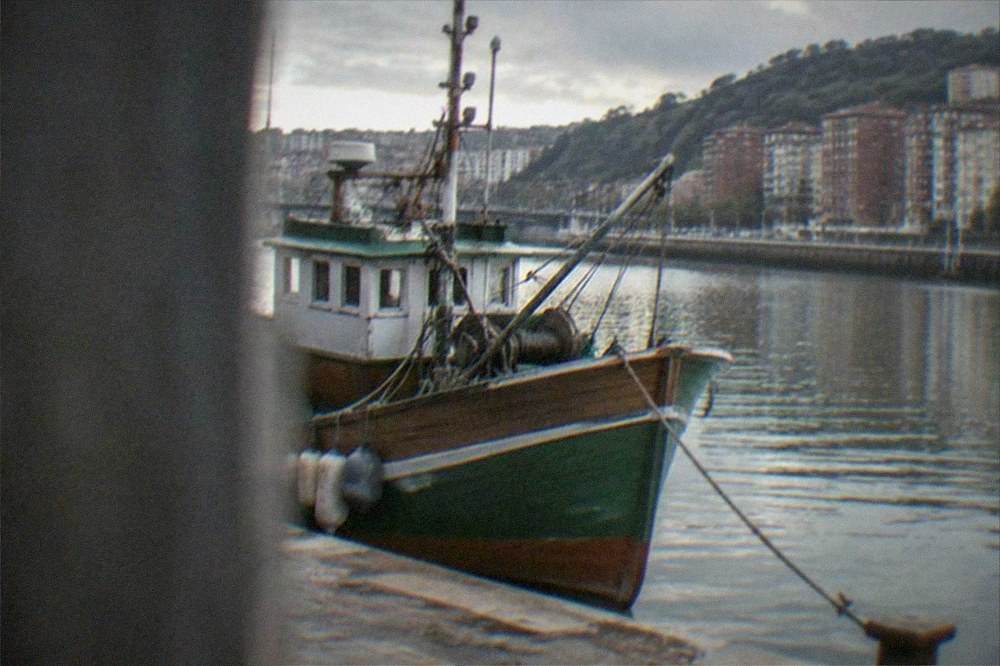
| Coastal towns like Bermeo and Mundaka | Basque-majority daily life | Fishing boats with Basque names, harbor chatter |
| Gernika's civic sites | Both | Bilingual plaques at the oak and assembly house |
The French side of the Basque Country is the most striking extension of the story. Basque is spoken on both sides of the border, in Bayonne, Saint-Jean-de-Luz and the villages of Iparralde, though under a different legal status in France than it enjoys in Spain. A day trip across the Bidasoa river lets you hear the same language in a French accent and see how a single culture spans a national frontier. The French Basque Country excursion is the natural tour for this: Check availability on the operator's live listing, and read more in the best base in the Basque Country guide if you are weighing Bilbao against the coastal towns for a longer stay.
Back in the city, a guided walk is where the language becomes geography. The small-group Old Town walk covers the Seven Streets with a local guide, and the guides, like nearly all Basque Country guides, work in several languages. The three days in Bilbao itinerary and the is Bilbao expensive guide cover the planning around it.
Food is the other door into the language, because Basque food culture keeps its vocabulary intact. The Basque food tour and wine tasting walk pairs the pintxos bars with txakoli and the words that come with both, and the operator's live listing carries the current price and availability for your dates.
Common Questions About Basque Or Spanish In Bilbao
Is Basque or Spanish the main language in Bilbao?
Spanish is the majority spoken language in Bilbao, used day to day by most of the city's 346,933 residents, but Basque (Euskara) is co-official and is used by roughly a third of the population, appears on all public signage, and is the first language in many homes and schools. Both are official.
Do people in Bilbao speak English?
English is widely used in hotels, the Guggenheim Museum Bilbao, the main museums and tourist-facing businesses, and less so in traditional pintxos bars and neighborhood shops. A visitor with basic Spanish manages everywhere, and English alone covers the core tourist trail.
Is Basque related to Spanish?
No. Basque (Euskara) is a language isolate, Europe's only surviving pre-Indo-European language, with no known relatives. Spanish is a Romance language descended from Latin. The two share borrowed words after centuries of contact, but their grammar, vocabulary and origins are entirely separate.
What does Bilbao's Basque name "Bilbo" mean?
"Bilbo" is the Basque name for Bilbao, used in Basque-language writing, signage and local contexts. It appears on plaques and in literature, though "Bilbao" is the standard name in English and Spanish. The city's metro station for the Old Town, Zazpikaleak, means "the Seven Streets".
Should I learn Basque words before visiting Bilbao?
A few words are worth it and nothing more is expected. "Kaixo" (hello), "eskerrik asko" (thank you), "egun on" (good day) and "agur" (goodbye) cover the courtesies, and locals visibly appreciate the effort in a language they do not expect outsiders to attempt.
Is Basque spoken outside the Basque Country in Spain?
Basque is spoken across the Basque Autonomous Community (Bizkaia, Gipuzkoa, Araba/Alava) and Navarre in Spain, and in the French Basque Country (Iparralde) across the border. Its status differs on each side: co-official and state-supported in the Spanish autonomous community, with a weaker legal position in France.
The short version: arrive with your Spanish, keep your English as backup, and learn five words of Basque on the way. You will hear all three within your first hour in the city, and the Basque words are the ones you will go home remembering.