SIM Cards And Data In Bilbao
Staying online in Bilbao, in the Basque Country of northern Spain, is straightforward: the question is whether you need a local SIM card at all, or whether roaming or an eSIM covers your trip better.
Short answer
Most short visitors to Bilbao do not need a local SIM card: EU roaming covers most European phones, and an eSIM can be bought before departure. If you want a physical SIM, operator shops and resellers in central Bilbao sell prepaid plans, and the airport has a shop option before you reach the city.
Bilbao, the largest city in Biscay (Bizkaia) province in the Basque Country of northern Spain, is a city where a working data connection quietly improves almost every part of the day: checking metro times, booking a museum slot, finding the next pintxos bar in the Seven Streets of the Casco Viejo, or confirming a day-trip departure. This guide walks through the realistic options for SIM cards and data in Bilbao, what each one is good for, and how your connection fits the verified prices and schedules you will be using once you land. The editorial desk behind this Bilbao Travel Guide has not visited the city; every figure below comes from an official or primary source, and where a figure is single-source it is labelled as reported rather than stated as settled fact.
Do You Need A SIM Card In Bilbao At All?
Most short-stay visitors to Bilbao do not need a physical SIM card, because three other routes usually cover a city break: EU roaming on a European plan, an eSIM installed before departure, or a mix of hotel WiFi and offline maps. A local prepaid SIM only earns its place on longer stays, for heavy data users, or when your home plan charges high roaming fees.
The honest starting point is that Bilbao is not a city where connectivity decides your trip. It is a compact, walkable city of about 346,933 residents (Eustat's municipal register, 1 January 2025), with an efficient metro, tram and bus network, and signage that works fine without a live connection. Offline map downloads of the Casco Viejo and the Abandoibarra museum district cover most walking navigation. What data genuinely adds is live information: museum ticket availability, timed-slot booking for San Juan de Gaztelugatxe on controlled-access days, and real-time decisions about which pintxos bar has a free table.
For European visitors, roaming is the first thing to check before buying anything. Spain is a European Union member and a founding-era Schengen country, so there is no separate visa or border formality for most European travelers, and standard EU roaming arrangements generally apply; the exact terms depend on your home operator's plan, so confirm with them rather than assuming. For travelers from the United States, the United Kingdom or further afield, roaming works but the per-megabyte or per-day charges vary enormously by carrier, and this is exactly where an eSIM or a local prepaid SIM becomes worth the ten minutes it takes to set up.
Where Can You Buy A SIM Card In Bilbao?
The two realistic purchase points for a physical SIM card in Bilbao are Bilbao Airport (BIO) on arrival and operator or reseller shops in the city centre, mostly around the Ensanche and Gran Via area; eSIMs, by contrast, are bought online before you fly and activated on landing. Airport purchases cost a little more for the convenience, while city-centre shops need a short trip after you have checked in.
Bilbao Airport is small by major-city standards, which cuts both ways: you will not walk far to find what you need, but the retail choice is narrower than at Madrid or Barcelona. The airport's arrivals level is where the Bizkaibus counter and the taxi rank sit, and it is the natural place to look for a SIM if you want connectivity for the ride into town. The airport is about 15 to 25 minutes from the centre by the A3247 bus, which runs every 15 minutes roughly from 06:10 to 23:40 from the airport and 05:00 to 22:00 from the city, at a fare of 5 EUR without a Barik card, so a SIM bought at the airport is working before you even board. More detail on the airport itself is in the Bilbao airport guide.
In the city, the main Spanish mobile operators, Movistar, Vodafone, Orange and Yoigo, all maintain a presence in Bilbao, and their flagship shops cluster in the Ensanche commercial district around Gran Via, a short walk from Moyua plaza. Prepaid ("prepago") plans are the standard tourist product: you pay for a bundle of calls, texts and data, and top up if it runs out. Bring your passport; Spanish law requires ID registration for any SIM purchase, and the shop will scan it during activation. Resellers and electronics shops also stock starter packs, sometimes at lower prices than operator boutiques, though the desk cannot verify any individual shop's current stock or pricing, so treat shop-level recommendations as things to confirm on the day rather than promises.
The table below puts the two airport-to-city options side by side, since it is usually the first journey your new SIM helps you research.
| Option | Frequency / availability | Journey time | Cost (verified) |
|---|---|---|---|
| Bizkaibus A3247 | Every 15 min; ~06:10-23:40 from airport, ~05:00-22:00 from Bilbao | 15-25 minutes | 5 EUR single without Barik |
| Taxi from the rank | 24/7 rank outside Arrivals, Level 1 | ~10-15 minutes | approx 24-29 EUR to centre (day/night bands) |
Note what is missing from that airport picture: there is no metro or train link to Bilbao Airport, and the city council's own position is that none arrives before 2035. Any app or guide that promises a rail connection is wrong, and this is exactly the kind of detail a live data connection lets you double-check on the spot.
How Does An eSIM Compare With A Physical SIM For Bilbao?
An eSIM is the better choice for visitors to Bilbao who cannot roam cheaply, because it is bought and installed from home before departure, activates on landing, and avoids the passport-registration queue in a shop; a physical prepaid SIM suits longer stays, people whose phone has no eSIM support, and anyone who wants a local number.
The practical difference is setup friction. An eSIM profile is purchased online and installed on a compatible phone in minutes; you land, toggle it on, and you have data before you have left the terminal. A physical SIM requires finding a shop, queuing, showing your passport and waiting for activation, which can take from ten minutes to an hour depending on the shop. The trade-off is that eSIM plans from international providers are data-only in most cases: fine for maps, bookings and messaging apps, less good if you specifically need a Spanish phone number for calls or SMS verification. A prepaid local SIM from a Spanish operator typically includes a Spanish number.
Check your phone's eSIM support before buying anything; most phones released in the last few years support it, but older handsets do not, and that is the one hard blocker. If you use a US carrier phone, confirm it is unlocked for foreign SIMs or eSIMs before you travel, because a locked phone accepts neither. The desk cannot quote eSIM or prepaid plan prices, and inventing them would be worse than silence; check the operator's live listing or the eSIM provider's app for current rates.
One planning note that belongs in this decision: Bilbao's weather rewards a working connection. AEMET's Bilbao Aeropuerto/Loiu station (1082), 1981-2010 normals, show 1,134 mm of rain a year, with November the wettest month at 147 mm, and a temperate oceanic climate that can shift plans by the hour. A data connection is what lets you swap a riverside walk for a museum afternoon at short notice. The Bilbao weather guide has the full month-by-month picture.
What Will You Actually Use Data For In Bilbao?
The everyday uses of data in Bilbao are live transit times and fare checks on Metro Bilbao, Bilbobus and the tram, timed-slot bookings for San Juan de Gaztelugatxe on controlled-access days, museum ticket purchases, and navigation between the Casco Viejo, the Ensanche and the Abandoibarra riverfront; none of these need heavy gigabytes, and a modest plan covers a typical city break.
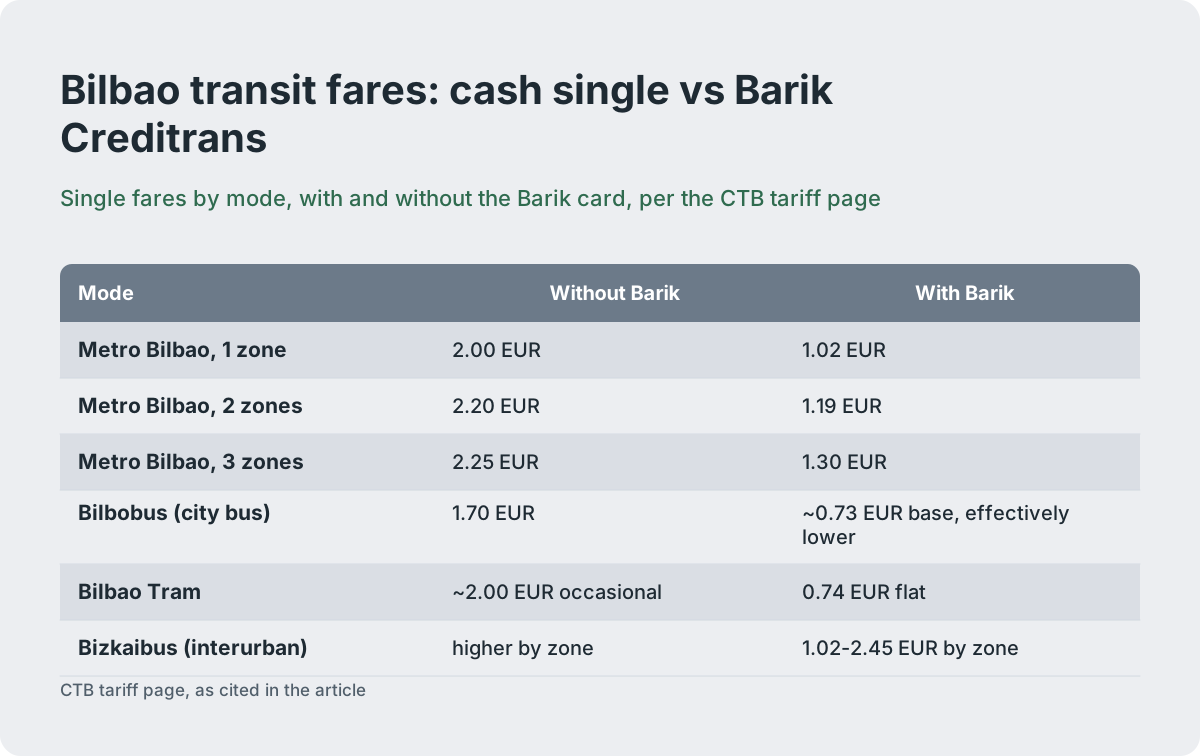
Transit is the big one. Bilbao's transport system runs on the Barik card, and the fare difference between paying with Barik and paying cash is large enough that you will want to look it up on the day. The CTB's own tariff page gives Metro Bilbao singles without Barik at 2.00 EUR for one zone, 2.20 EUR for two and 2.25 EUR for three, valid two hours; with a Barik Creditrans the same journeys cost 1.02, 1.19 and 1.30 EUR. A Bilbobus single is 1.70 EUR, about 0.73 EUR base with Barik and effectively lower after the frequent-user discount. The tram is a flat 0.74 EUR with Barik, around 2.00 EUR occasional. The Barik card itself is commonly reported to cost about 3 EUR to buy, non-refundable, though the desk flags that this purchase price comes from a weaker source than the official CTB page, so treat it as reported rather than official. Full detail is in the getting around Bilbao transport guide.
| Mode | Single without Barik | With Barik Creditrans |
|---|---|---|
| Metro Bilbao, 1 zone | 2.00 EUR | 1.02 EUR |
| Metro Bilbao, 2 zones | 2.20 EUR | 1.19 EUR |
| Metro Bilbao, 3 zones | 2.25 EUR | 1.30 EUR |
| Bilbobus (city bus) | 1.70 EUR | ~0.73 EUR base, effectively lower |
| Bilbao Tram | ~2.00 EUR occasional | 0.74 EUR flat |
| Bizkaibus (interurban) | higher by zone | 1.02-2.45 EUR by zone |
The second everyday use is bookings. The Guggenheim Museum Bilbao's own site lists adult admission at 18 EUR, open Tuesday to Sunday 10:00 to 19:00, extending to 20:00 during Easter week and from 15 June to 13 September, and buying tickets online is the standard way to skip the desk queue. The Bilbao Fine Arts Museum is closed from 31 August to 5 October 2026 for final renovation works and, as reported, reopens 6 October 2026 with a free entry week from 6 to 13 October; from 14 October adult admission is 12 EUR, with a joint Artean pass covering both museums at 16 EUR general. Those single-source reopening details are worth a live check on the museum's own page before you plan a morning around them. More museum-by-museum detail is in the Bilbao museums guide.
How Much Data Do You Need For A Bilbao Trip?
A city break in Bilbao of two to four days typically runs comfortably on a small-to-mid data bundle, because the heavy consumers are maps, transit lookups and messaging rather than streaming, and hotel and cafe WiFi absorbs the large downloads; the usage pattern itself is light.
What actually eats data in Bilbao is video streaming and cloud backups, not navigation. Map apps use surprisingly little once the city map is downloaded for offline use, which is worth doing on hotel WiFi the night you arrive. Transit lookups and booking pages are text-light. If you plan to upload photos of the Guggenheim's titanium curves or the Vizcaya Bridge to cloud storage as you go, that is where a bigger bundle earns its price, and even then, doing it on nightly WiFi is the cheaper habit.
To put the trip's data-adjacent costs in one place, here are the verified admission and crossing prices your phone will be looking up.
| Attraction / service | Verified price | Note |
|---|---|---|
| Guggenheim Museum Bilbao, adult | 18 EUR | Tue-Sun 10:00-19:00, to 20:00 Easter week and 15 Jun-13 Sep |
| Bilbao Fine Arts Museum, adult | 12 EUR | From 14 Oct 2026, as reported; under-18 free |
| Artean joint pass (both museums) | 16 EUR general / 8 EUR reduced | As reported |
| San Mames self-guided museum visit | 15 EUR adult | Audio guide in ES/EU/EN/FR |
| San Mames guided Museum + Tour | 22 EUR adult | Children 5-14: 8 EUR |
| Vizcaya Bridge gondola crossing | 0.60 EUR one-way | Daytime pedestrian fare |
| Vizcaya Bridge walkway ticket | 11 EUR adult round-trip | Single-source figure, as reported; reduced 9 EUR |
The Vizcaya Bridge, a UNESCO World Heritage Site since 2006 and the first industrial heritage site in Spain on the list, sits at Portugalete and Getxo on the metro's Line 1, about a 20 to 29 minute ride from the centre at 2 to 3 EUR, so it is a data-light half day: one metro lookup, one gondola crossing, one photo of the world's only operating transporter bridge of its kind still carrying passengers.
Does Your Phone Work For Day Trips From Bilbao?
Yes, the same SIM, eSIM or roaming plan that works in Bilbao works across the whole of Spain and, with roaming terms, into France, which matters because Bilbao's best day trips range from Gaztelugatxe and the Urdaibai coast to San Sebastián and the French Basque Country, and cross-border coverage depends on your plan's roaming terms rather than on any local network quirk.
The Basque coast is where a working connection stops being a convenience and starts being a small travel tool. San Juan de Gaztelugatxe, the rocky hermitage islet reached by a stone causeway and a long stepped climb, requires a free timed reservation only on official "controlled access" days, roughly mid-June to about 20 September daily plus Easter and holiday weekends per the yearly calendar, and it is free without reservation on all other days. The daily cap on controlled days is 1,462 visitors, booking is always free through tiketa.eus with a maximum of 10 people per reservation, and reservations are typically cancelled if you are more than 60 minutes late for your slot. That is a booking you want to make from your phone, sometimes weeks ahead. The Gaztelugatxe guide covers the calendar in detail.
San Sebastián, about an hour and twenty minutes by direct bus from Bilbao's Intermodal station, and the French Basque towns of Biarritz and Saint-Jean-de-Luz sit across a border that Schengen makes invisible on the ground but that your phone plan may still treat as international. EU roaming rules generally cover Spain and France together for European plans; travelers on US or UK plans should check whether France is included, because a day trip to Saint-Jean-de-Luz on a plan that charges for France can produce an unpleasant bill. This is one of the few genuinely important connectivity decisions specific to this region, and it is worth five minutes with your carrier's app before you go.
If you would rather leave the navigation entirely to someone else, guided day trips cover the coast and the border country with the driving and timings handled. The Rioja and Laguardia tour heads inland to the wine country instead, a full day that pairs well with a morning of museum bookings in the city. Check availability if the wine region is on your list.

What About WiFi, Hotspots And Backup Options In Bilbao?
Hotel WiFi in Bilbao is the default backbone of many visitors' connectivity, and it is usually enough combined with a modest mobile allowance, but public WiFi should be treated as a convenience rather than a plan, because coverage on streets, in transit and at coastal day-trip sites is patchy, and sensitive tasks like banking belong on your own connection or a hotspot.
The realistic architecture of a connected Bilbao trip is layered: hotel or apartment WiFi for the heavy lifting (map downloads, photo backups, research), a mobile plan for everything on the street, and a healthy scepticism about open public networks for anything involving passwords. Coffee shops and pintxos bars increasingly offer WiFi, but Bilbao's pintxos culture is a standing-and-moving affair rather than a laptop-and-linger one, so bar WiFi is more a bonus than a strategy. If several people travel together, one phone as a hotspot for the group is often the cheapest single purchase, though it concentrates the battery drain on one device, and a small power bank fixes that more cheaply than a second SIM.
Battery, in fact, deserves a sentence of its own in a connectivity guide: a day that starts with the Guggenheim, walks the riverfront to the Casco Viejo, and ends on a pintxos crawl through Plaza Nueva will outlast most phone batteries if maps and camera are in constant use. The charging infrastructure in bars and on transit is not something we can vouch for, so carry your own. For the money side of the trip beyond connectivity, the is Bilbao expensive guide and the ATM, cash and cards guide cover what to expect.
One dated planning fact belongs here, because it is the kind of thing your connection should surface before you book: Bilbao currently has no tourist tax in 2026, but a Bizkaia-wide regional tax (Norma Foral 3/2026) takes effect on 1 January 2027, with Bilbao's approved municipal rates running from 1 EUR per night at pensions to 5 EUR at five-star hotels and 6.50 EUR for tourist apartments. If you are booking 2027 accommodation, factor it in; if you travel in 2026, it does not apply to you.
| Accommodation type | Approved tourist tax per night, from 1 Jan 2027 |
|---|---|
| 5-star hotels | 5 EUR |
| 4-star hotels | 4 EUR |
| 3-star hotels | 2 EUR |
| 2-star hotels | 1.50 EUR |
| Pensions | 1 EUR |
| Tourist apartments (VUT) | 6.50 EUR |

How Does Connectivity Fit A Full Bilbao Itinerary?
Connectivity in Bilbao fits the itinerary rather than driving it: the city's headline sights, from the Guggenheim and the Fine Arts Museum to the Casco Viejo, the Ribera Market and the Artxanda funicular, are all reachable with offline planning, and data mainly smooths bookings, transit fares and same-day weather swaps across a two-to-four-day visit.
A typical first day runs the Abandoibarra riverfront: the Guggenheim, the Zubizuri and La Salve bridges, and the Euskalduna Palace, all within a walkable stretch. Day two goes to the Seven Streets of the Casco Viejo, the Cathedral of Santiago, Ribera Market and Plaza Nueva, where the pintxos bars Gure Toki, Sorginzulo and Víctor Montes anchor the crawl. Day three is the funicular up to Artxanda for the view, reported at 3.50 EUR one-way and 6.00 EUR round-trip as a single-source figure, or a metro ride out to Getxo and the Vizcaya Bridge. The how many days in Bilbao guide helps you pick the length, and the three days in Bilbao itinerary sequences it.
For transport across all of it, the Bilbao Bizkaia Card bundles unlimited travel with attraction discounts at 10 EUR for 24 hours, 15 EUR for 48 and 20 EUR for 72, personal and non-transferable, per the card's own site; whether it beats pay-as-you-go Barik depends on how much you ride, and the Bilbao Bizkaia Card guide does that arithmetic. The food side of the city, from pintxos crawls to the Michelin-starred tables of Nerua and Ola, is covered in the Bilbao food guide and the best pintxos in Bilbao guide, and a guided walk takes the research load off your data plan entirely.
The wider region rewards the same approach. Whether Bilbao or San Sebastián makes the better base is a real question with a real answer depending on your priorities, laid out in the Bilbao vs San Sebastian guide, and the best base in the Basque Country guide widens it to Vitoria-Gasteiz and the coast.
Whichever connectivity route you settle on, the same logic applies to the region's biggest draws: a guided day trip takes the live logistics off your phone entirely, which is a genuine relief when a coastal reservation window, a museum closing time and a bus timetable all have to line up on the same morning. These are the day trips that pair best with a Bilbao base.
Common Questions About SIM Cards And Data In Bilbao
Do I need a SIM card in Bilbao?
Most short visitors do not. EU roaming covers many European plans, eSIMs can be installed before departure, and hotel WiFi plus offline maps handles a typical city break. A physical prepaid SIM suits longer stays or heavy data users.
Where can I buy a SIM card in Bilbao?
At Bilbao Airport on arrival, or at operator and reseller shops concentrated in the Ensanche district around Gran Via in the city centre. Bring your passport: Spanish law requires ID registration for every SIM purchase.
Is there free WiFi in Bilbao?
Hotels and many cafes and pintxos bars offer WiFi, but street-level coverage is patchy and should not be relied on as a plan. Treat open public networks as a convenience, and do banking and passwords on your own connection.
Will my US phone work in Bilbao?
Spain uses standard European network bands, so most modern unlocked phones work. Confirm with your carrier whether your plan includes Spain or charges roaming, and check that your handset is unlocked before buying a local SIM or eSIM.
Does my phone work on day trips to France from Bilbao?
Yes, the same hardware works across the border in the French Basque Country, but whether it costs extra depends on your plan's roaming terms. Travelers on US and UK plans should specifically check that France is included before a Biarritz or Saint-Jean-de-Luz day trip.
How much data do I need for Bilbao?
Less than you might expect: maps, transit lookups and bookings are light users, and offline map downloads cut usage further. Streaming and photo backups are the heavy consumers, and doing those on hotel WiFi keeps a modest bundle sufficient.
The bottom line for SIM cards and data in Bilbao is proportion: the city is small, legible and well served by transit, so connectivity is a lubricant rather than a lifeline, and a modest roaming plan, eSIM or prepaid SIM, bought where it suits you, covers everything from the Guggenheim's ticket page to a free timed slot at Gaztelugatxe.