Money, Tipping And Costs In Bilbao
Bilbao, in Spain's Basque Country, runs on the euro, tips far more lightly than most of Spain, and costs less than San Sebastián for the same pintxos-and-museums day out. Here is what to budget, what to tip, and what not to worry about.
Short answer
Bilbao uses the euro (EUR). Tipping is optional and modest: round up a bar bill or leave a euro or two at a restaurant, and nobody expects percentages. A pintxo runs about 2 to 5 EUR, the Guggenheim costs 18 EUR, and there is no tourist tax in 2026; one arrives across Bizkaia on 1 January 2027.
Bilbao, the largest city of Biscay (Bizkaia) province in the Basque Country of northern Spain, uses the euro, tips lightly, and keeps costs reasonable for a city with a world-class museum and one of Europe's great food scenes. Money here behaves differently from southern Spain: portions of the budget go further on food, cards are accepted almost everywhere, and the service charge question that stresses travelers in Madrid or Barcelona barely registers in a Bilbao pintxos bar. This guide covers the currency, the tipping etiquette, the real cost of a day, and one dated change worth knowing before you book: a regional tourist tax arrives across Bizkaia on 1 January 2027, and current-year visitors pay nothing. The Bilbao Travel Guide desk keeps every figure on this page tied to an official or verified source.
What Currency Does Bilbao Use?
Bilbao uses the euro (EUR), Spain's currency, and no other currency is accepted anywhere in the city. Prices are quoted with the euro symbol, cards are taken nearly everywhere, and there is no local Basque currency or parallel money system of any kind. If you arrive from another eurozone country, you change nothing at all; if you arrive from the United States or the United Kingdom, you exchange before you spend.
Spain is a founding Schengen member, so a traveler arriving from France, for example, crosses no border check and no currency boundary on the way to Bilbao. The practical consequence for money is simple: everything from the airport bus to the Guggenheim ticket desk is priced in euros, and the only question is how you carry them.
Cash still matters, but less every year. A few Old Town bars and market stalls prefer small notes, and having a handful of five-euro bills makes a pintxos crawl smoother. Beyond that, contactless cards work on Bilbao's metro validators, on Bilbobus, on the tram, and at virtually every restaurant and shop a visitor will enter. ATMs are dense around Abando and the Casco Viejo; bank-owned machines give fair rates, while standalone machines in tourist zones deserve the usual caution.
Do You Tip In Bilbao?
Tipping in Bilbao is optional, modest and never percentage-based: rounding up a pintxos bill to the nearest euro, or leaving one or two euros on a restaurant table, is the full local custom. Nobody tips at a bar counter, taxi fares are rounded to the nearest euro, and hotel staff are not tipped for ordinary service. A service charge is already included in restaurant prices by law, so a tip is a thank-you, not an obligation.
This is the single biggest money question visitors ask, and the answer is more relaxed than most guidebooks imply. Spain includes service in menu prices, and the Basque Country is on the lighter end of even Spanish custom. In a pintxos bar you pay at the counter or when the bartender chalks up your tally; leaving coins in a small dish is appreciated but entirely at your discretion. At a sit-down dinner, a couple of euros for good service is generous by local standards, and ten percent would mark you as a very satisfied visitor rather than a normal one.
| Situation | Local custom | Typical amount |
|---|---|---|
| Pintxos bar counter | Optional, coins in the dish | Round up to nearest euro |
| Casual sit-down meal | Optional, leave on table | 1-2 EUR |
| Upscale restaurant | Appreciated for good service | A few euros, not a percentage |
| Taxi | Round up | Nearest euro, occasionally 1 EUR extra |
| Hotel porter | Not expected | 1-2 EUR if you insist |
| Free walking tour | Tip-based, the exception | What you feel the walk was worth |
One exception deserves its own line: free walking tours. The two GuruWalk free tours of Bilbao's historic center and the Guggenheim exterior run on tips alone, so the etiquette inverts. There, the tip is the payment, and you hand it to the guide directly at the end. For everything else, the best pintxos bars in Bilbao will happily take your exact change.
How Much Does A Day In Bilbao Cost?
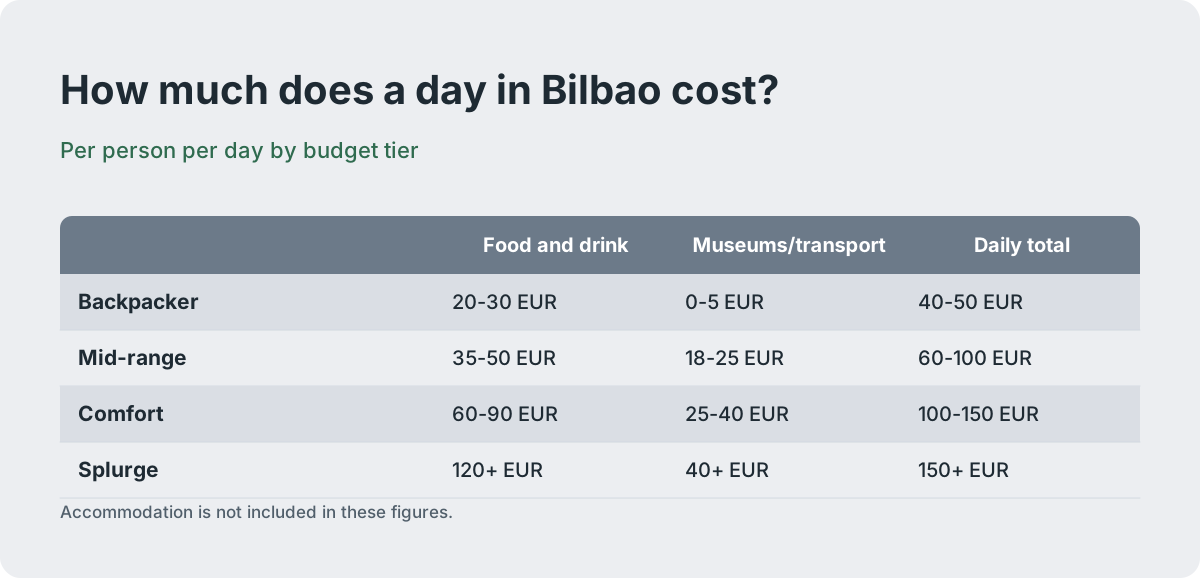
A comfortable day in Bilbao costs roughly 60 to 100 EUR per person: about 15 to 25 EUR for pintxos across a day, 18 EUR for the Guggenheim, a few euros on the metro, and the balance on a proper restaurant dinner. A budget traveler can hold a day near 40 EUR by eating standing at bars and skipping paid museums, while a splurge day with a starred restaurant easily passes 150 EUR. Accommodation is not included in these figures.
Bilbao sits in a comfortable middle tier of Spanish city costs, cheaper than San Sebastián and Barcelona for comparable food, and the is Bilbao expensive question gets a firm "less than you feared" from the numbers. The food scene is the reason: the bar culture that would cost double in a capital is priced for locals here, and a crawl of four or five pintxos with drinks lands in the 25 to 45 EUR range per person, per the 2026 price reporting gathered for this site.
| Daily budget tier | Food and drink | Museums and transport | Realistic daily total per person |
|---|---|---|---|
| Backpacker | 20-30 EUR | 0-5 EUR | 40-50 EUR |
| Mid-range | 35-50 EUR | 18-25 EUR | 60-100 EUR |
| Comfort | 60-90 EUR | 25-40 EUR | 100-150 EUR |
| Splurge | 120+ EUR | 40+ EUR | 150+ EUR |
The Guggenheim at 18 EUR is the anchor expense, and the Bilbao Bizkaia Card changes the arithmetic for heavy sightseers: the card runs 10 EUR for 24 hours, 15 EUR for 48 and 20 EUR for 72, bundling unlimited transport with attraction discounts, per the card's own site. Two museum visits plus a day of metro rides can already clear the 24-hour price. The full breakdown lives in the Bilbao Bizkaia Card guide.
If a guided experience is on your list, this is the moment to book it, since food tours and day trips are the two categories where prices move with demand.
How Much Do Pintxos And Meals Cost In Bilbao?
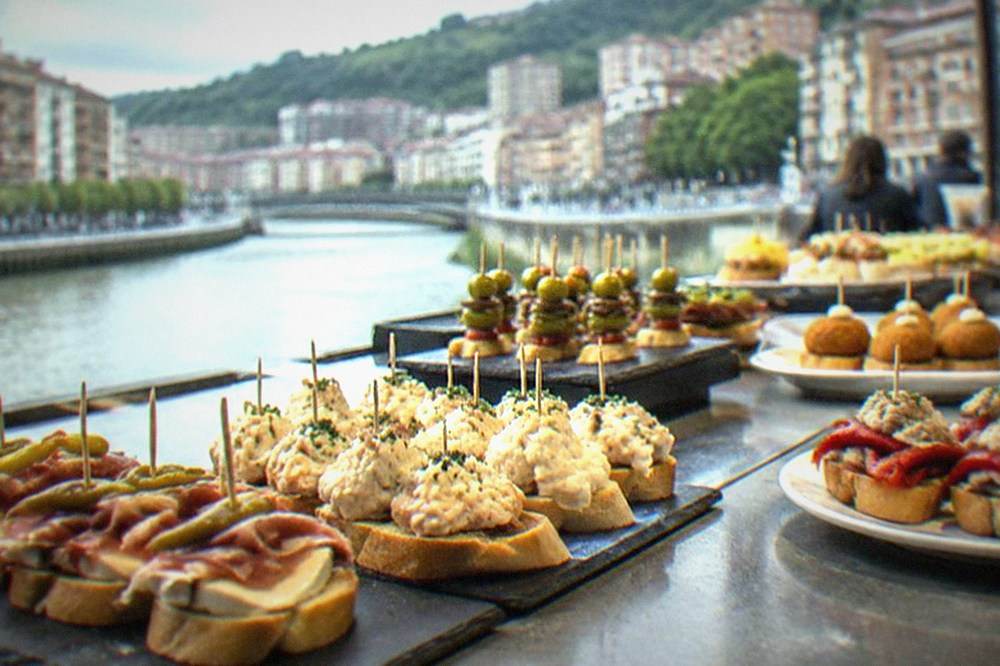
A single pintxo at a traditional Bilbao bar costs roughly 2 to 5 EUR, with simpler counter items at the low end and hot, elaborate bites at the top; drinks run 2 to 3.50 EUR for txakoli, a zurito or a glass of wine. A full crawl of four to six pintxos with drinks lands around 25 to 45 EUR per person, and a sit-down dinner at a quality non-starred restaurant runs meaningfully more.
The 2026 price reporting for this site puts counter basics like gildas, tortilla and jamon at 2 to 4 EUR, and hotter or more creative pieces, such as seafood gratins, at 3 to 6 EUR, with premium spots reaching 6 to 8 EUR on their showpiece bites. One widely reported detail: a neighborhood bar held its tortilla at 2.60 EUR despite rising costs, a sign that Old Town price discipline is real and not just marketing.
| Item | Typical price in 2026 |
|---|---|
| Simple cold pintxo (gilda, tortilla, jamon) | 2-4 EUR |
| Hot or elaborate pintxo | 3-6 EUR |
| Premium showpiece pintxo | 6-8 EUR |
| Txakoli, zurito or wine | 2-3.50 EUR |
| Full crawl, 4-6 items plus drinks | 25-45 EUR |
The Michelin tier is a different conversation. The 2026 Michelin Guide kept Azurmendi at three stars in Larrabetzu just outside the city, and Bilbao proper holds one star each at Ola, Nerua inside the Guggenheim, Mina, Zarate and the newly starred Islares, whose menus are reported around 98 to 135 EUR. Those figures come from the late-2025 Michelin announcement coverage; the starred tier is a reservation project, not a walk-in decision. For the everyday tier, the Bilbao food guide maps the neighborhoods, and a guided crawl removes the guesswork entirely.
What Do Bilbao's Museums And Attractions Cost?
The Guggenheim Museum Bilbao charges 18 EUR for an adult ticket, the Fine Arts Museum will charge 12 EUR for general admission from 14 October 2026 after its reopening, and the San Mames stadium tour runs 15 EUR self-guided or 22 EUR guided for adults. The Vizcaya Bridge gondola crossing costs 0.60 EUR one way, making it a remarkably cheap UNESCO World Heritage experience.
The Guggenheim's own hours-and-admission page lists the 18 EUR adult ticket, with 9 EUR for students aged 18 to 25 and for seniors over 65, free entry under 18, and extended 20:00 closing during Easter week and from 15 June to 13 September. The Fine Arts Museum reopens on 6 October 2026 after its renovation, with a free week from 6 to 13 October, and the 12 EUR general admission from 14 October is a single-source reported figure. A joint Artean pass covering both museums is reported at 16 EUR general, 8 EUR reduced.
| Attraction | Adult price | Notes |
|---|---|---|
| Guggenheim Museum Bilbao | 18 EUR | Under-18 free; 9 EUR student/senior |
| Bilbao Fine Arts Museum | 12 EUR | From 14 Oct 2026, as reported |
| Artean joint pass, both museums | 16 EUR | 8 EUR reduced, as reported |
| San Mames self-guided tour | 15 EUR | Audio guide included |
| San Mames guided tour | 22 EUR | Museum plus stadium |
| Funicular de Artxanda | 3.50 EUR one way | 6 EUR round trip, as reported |
| Vizcaya Bridge gondola | 0.60 EUR | Daytime one-way fare |
San Mames pricing comes from the Athletic Club museum's own practical-information page: 15 EUR adult self-guided with an audio guide in Spanish, Basque, English and French, 22 EUR for the guided museum-plus-stadium tour, with reduced rates for children and members. The funicular's 3.50 EUR one-way fare is a single-source reported figure pending independent confirmation. The museums half of the equation, including the free walking options around the Guggenheim, is covered in the Bilbao museums guide.
How Do You Pay In Bilbao: Cards, Cash And Contactless?
Cards are accepted nearly everywhere in Bilbao, including on the metro, Bilbobus and the tram through contactless validators, so a visitor can run the city almost cashless with just a few euros for old-school bars. The one payment decision that genuinely saves money is the Barik card, the regional transit card that cuts a 2.00 EUR metro single in Zone 1 to 1.02 EUR, per the official CTB fares page.
The CTB Barik fares page gives the full picture: metro rides with a Barik cost 1.02 EUR in Zone 1, 1.19 EUR in Zone 2 and 1.30 EUR in Zone 3, while occasional tickets without the card run 2.00, 2.20 and 2.25 EUR. Bilbobus charges 1.70 EUR for a single but effectively around 0.44 EUR with Barik after discounts. The tram is 0.74 EUR flat with Barik against roughly 2.00 EUR without. The card itself is commonly reported to cost 3 EUR to buy, a figure from a weaker source than the official fares page, so treat the purchase price as provisional.
| Payment method | Where it works | What to know |
|---|---|---|
| Contactless bank card | Metro, tram, shops, most bars | Standard in 2026 |
| Barik card | All public transport | Cuts fares roughly in half |
| Cash | Everywhere, preferred at some market stalls | Keep small notes for pintxos crawls |
| Bizkaibus A3247 airport bus | Card or cash at driver or desk | 5 EUR without Barik |
The airport bus is the one cash-relevant ride to plan for: the A3247 costs 5 EUR without a Barik card, payable by card or cash at the driver or the airport Bizkaibus desk, per the Bizkaibus airport page. A taxi from the airport runs approximately 24 to 29 EUR to the center, with no airport supplement and the Artxanda tunnel toll included in the guidance price. Full transport detail lives in the getting around Bilbao transport guide, and arrival logistics in the Bilbao airport guide.
Is There A Tourist Tax In Bilbao?
There is no tourist tax in Bilbao in 2026, but one arrives across Bizkaia on 1 January 2027 under Norma Foral 3/2026, approved in June 2026. Bilbao's municipal plenary set the rates in September 2026: 5 EUR per night at 5-star hotels, 4 EUR at 4-star, 2 EUR at 3-star, 1.50 EUR at 2-star, 1 EUR at pensions, and 6.50 EUR for tourist apartments. Reservations made before early February 2026 are generally exempt.
This is the planning detail almost no other coverage has, because the municipal vote happened only days before this site's research was compiled. The regional Norma Foral, published by the Basque municipal association, sets the framework across Bizkaia, and Bilbao's own rates were approved in late September 2026 reporting by the provincial press. The tax applies per adult per night, capped at roughly five to six nights, with exemptions for minors and medical stays.
| Accommodation type | Approved 2027 rate per night |
|---|---|
| 5-star hotel | 5 EUR |
| 4-star hotel | 4 EUR |
| 3-star hotel | 2 EUR |
| 2-star hotel | 1.50 EUR |
| Pension | 1 EUR |
| Tourist apartment (VUT) | 6.50 EUR |
Two practical takeaways. First, if you travel in 2026, the line item does not exist yet: no hotel will add it, and no guide that tells you otherwise is current. Second, if you book a 2027 stay, budget a euro or two per night at ordinary hotels, and note that tourist apartments carry the maximum 6.50 EUR rate, a deliberate deterrent in the municipal ordinance. Where to sleep in the first place is a separate question, handled in the where to stay in Bilbao guide.
What Money Mistakes Do Visitors Make In Bilbao?
The three money mistakes visitors make in Bilbao are over-tipping out of American habit, paying single fares on public transport instead of loading a Barik card, and assuming the Guggenheim is the only paid attraction worth budgeting for. A fourth is arriving in 2027 without knowing the new tourist tax exists. None of these are dangerous, and the city ranks among Spain's safer major cities per local reporting on 2025 crime data, so money errors here cost euros, not safety.
Over-tipping is the most common. A party that leaves 15 percent at a pintxos bar is not offensive, but it marks the table as foreign and drains a daily budget faster than any museum. The local norm, rounding up or a euro or two, is both correct and cheaper.
The Barik question is the most expensive to get wrong. A traveler who takes the metro twice a day for three days without a Barik pays 2.00 EUR a ride instead of 1.02 EUR, roughly 12 EUR lost across a short trip, before counting buses and the tram. The card pays for itself inside a day of ordinary sightseeing.
The third mistake is under-budgeting the food scene's ceiling. It is easy to arrive planning 30 EUR days of pintxos and then discover the Michelin tier, the cider houses, or the Bilbao nightlife guide and double the food line. Plan the splurge deliberately rather than discovering it hungry.
A guided pintxos crawl also solves the tipping question by accident: the guide handles every bar bill, the drinks arrive without negotiation, and the only cash that changes hands is whatever you choose to hand the guide at the end. For travelers who find the chalk-tally bar ritual intimidating, that alone justifies the ticket price, and it turns the evening into a lesson in how locals actually spend.
How Does Bilbao Compare On Cost To San Sebastian?
Bilbao is the cheaper of the two Basque heavyweights for the same style of trip: its pintxos, museum tickets and hotel-adjacent costs run below San Sebastián's across the board, while its flagship attraction, the 18 EUR Guggenheim, adds a paid anchor San Sebastián lacks. Bilbao also wins on transport cost, since a Barik-loaded metro day costs a couple of euros against San Sebastián's pricier intercity bus arrival.
The comparison matters because most northern Spain itineraries include both cities, and the order affects the budget more than the route. Arriving in Bilbao, eating through the Casco Viejo, and taking the 80-minute intercity bus to San Sebastián spreads the same money further than the reverse, because the expensive nights land where the food is cheaper. The full head-to-head, including atmosphere and itinerary fit, is in the Bilbao vs San Sebastian guide.
| Cost line | Bilbao | How it plays |
|---|---|---|
| Pintxos crawl | 25-45 EUR per person | Same style costs more in San Sebastián |
| Flagship museum | 18 EUR Guggenheim | San Sebastián has no equivalent paid anchor |
| City transport | ~1-2 EUR per ride with Barik | Compact center, minimal spend |
| Intercity bus between the two | Roughly 8-19 EUR one way | Book either direction, price is symmetric |
The intercity bus fare range comes from the current schedule aggregators gathered in this site's day-trip reporting. Neither city requires a car, and renting one in Bilbao only pays off for coastal loops like Gaztelugatxe, a decision covered in the renting a car in Bilbao guide.
Common Questions About Money And Tipping In Bilbao
What Currency Does Bilbao Use?
Bilbao uses the euro (EUR), Spain's currency. No other currency is accepted, and cards are taken nearly everywhere, including on public transport through contactless validators.
Do You Tip In Bilbao?
Tipping is optional and modest. Round up a pintxos bill, leave one or two euros at a restaurant, and skip percentages entirely. The exception is a free walking tour, where the tip is the payment.
How Much Does A Pintxo Cost In Bilbao?
A traditional pintxo runs roughly 2 to 5 EUR in 2026, with simple cold items at the low end and hot, elaborate bites higher. Drinks such as txakoli or a zurito run about 2 to 3.50 EUR.
Is There A Tourist Tax In Bilbao?
Not in 2026. A Bizkaia-wide tourist tax under Norma Foral 3/2026 takes effect on 1 January 2027, with Bilbao's approved rates running from 1 EUR per night at pensions to 5 EUR at 5-star hotels and 6.50 EUR for tourist apartments.
Should I Get A Barik Card For A Short Visit?
Usually yes. The Barik card cuts a 2.00 EUR metro single in Zone 1 to 1.02 EUR and applies similar discounts on buses and the tram, so it pays for itself within a day of ordinary sightseeing.
Can I Visit Bilbao Cashless?
Almost entirely. Contactless cards work on the metro, tram and buses and in nearly every bar and shop. Keep a few small notes for old-school market stalls and standing bars where exact change is appreciated.
Budget Bilbao around a 60 to 100 EUR mid-range day, tip like a local by rounding up, load a Barik card on day one, and if your trip slips into 2027, add a euro or two per night for the new regional tax.